# Token distribution model

## Minting and burning

One hundred million (100,000,000) IPOR tokens were minted at inception. The mint function is not available beyond the initial mint. Likewise, there is no burning method. The IPOR token is a simple non-upgradeable ERC20 contract.

## Token allocation

All vesting mentioned below starts at TGE.

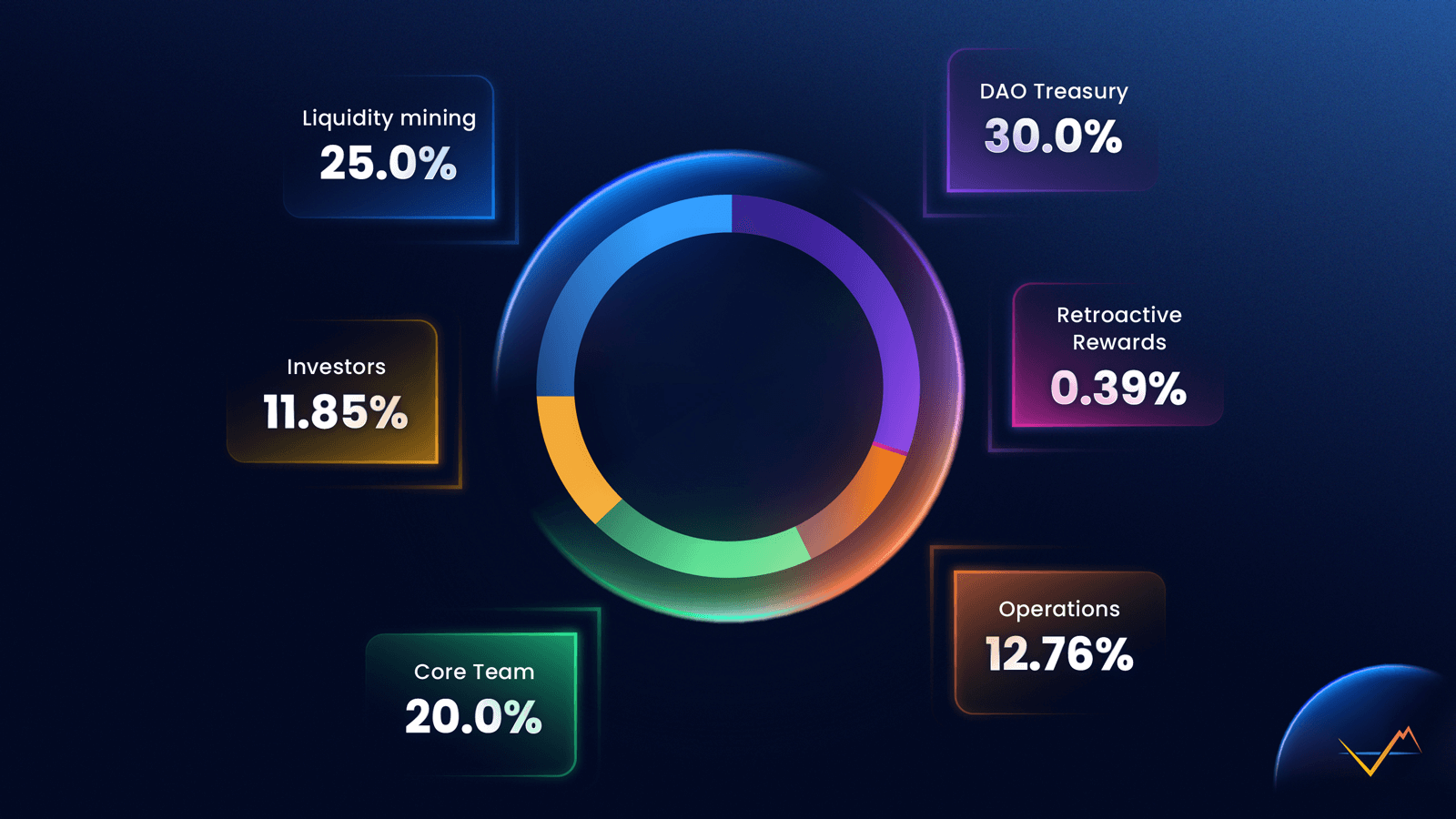
<table><thead><tr><th width="150">Share</th><th width="170">Who</th><th>Vesting details</th><th>Wallet Address</th></tr></thead><tbody><tr><td>30%</td><td>DAO Treasury </td><td>Governed by IPOR DAO</td><td><a href="https://etherscan.io/address/0x558c8eb91F6fd83FC5C995572c3515E2DAF7b7e0">0x558c8eb91F6fd83FC5C995572c3515E2DAF7b7e0</a></td></tr><tr><td>25%</td><td>Liquidity mining </td><td>Emission of 1.05 tokens per block. Can be adjusted by the DAO.</td><td><a href="https://etherscan.io/address/0x0b65625f905168EF24829fb625B177f83f1BFe6B">0x0b65625f905168EF24829fb625B177f83f1BFe6B</a></td></tr><tr><td>12.76%</td><td>Operations </td><td>No vesting. To be used by the DAO</td><td><a href="https://etherscan.io/address/0xB7bE82790d40258Fd028BEeF2f2007DC044F3459">0xB7bE82790d40258Fd028BEeF2f2007DC044F3459</a></td></tr><tr><td>20%</td><td>Core Team</td><td>Linear vesting over 3 years. No cliff. </td><td><a href="https://etherscan.io//address/0x41a3176aed445af3307be0f44f88c568c665e6f8#tokentxns">0x6f8c6Ae4e765a5d1fe07763B41c43453132C5D3d</a></td></tr><tr><td>11.85%</td><td>Investors </td><td>Linear vesting over 3 years. No cliff. </td><td>Multiple vesting walllets </td></tr><tr><td>0.39%</td><td>Retroactive Rewards </td><td>85,200 unlocked from 18.01.2023. 305,000 vesting 6 months from the same date.</td><td><a href="https://docs.google.com/spreadsheets/d/1v-UanyPFiNUPF-mYwwuvdb0mVQbjwI3874Rhlnqpctg/edit#gid=0">Multiple wallets</a>.</td></tr></tbody></table>

<figure><img src="/files/XnpiGxPKQx3V99L1Jh3y" alt=""><figcaption></figcaption></figure>

### Inflation rate

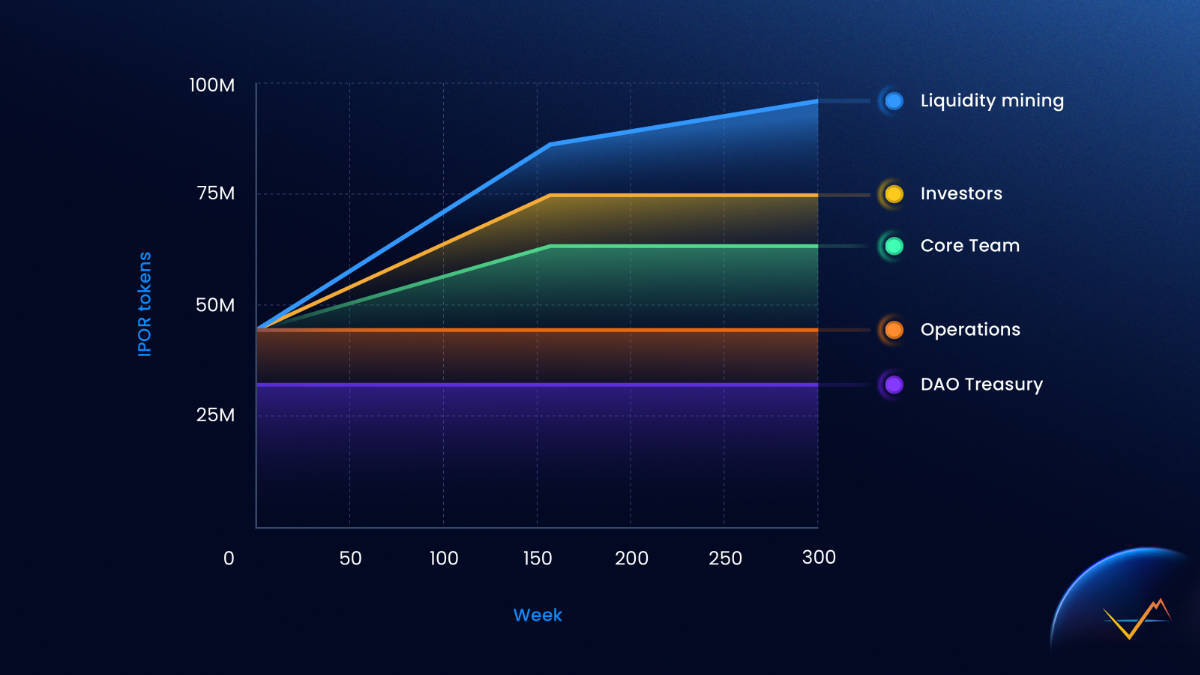
The IPOR Token emission starts with <mark style="color:purple;">retroactive rewards for early protocol users, followed by IPOR's Liquidity Mining model (</mark>[<mark style="color:purple;">Power Tokens</mark>](https://medium.com/ipor-labs/power-tokens-incentives-done-better-e9e88e38208b)<mark style="color:purple;">)</mark>. The initial liquidity mining emission rate started at 10,800 pwIPOR tokens per day for the first 3 months.&#x20;

Issuance details are displayed in the chart below.

<figure><img src="/files/YNxW88jtVxmoRgH7hbwA" alt=""><figcaption></figcaption></figure>

### Further Liquidity Mining Adjustments

After a successful [vote in IPOR's Economic Working Group](https://blog.ipor.io/liquidity-mining-changes-approved-ipor-emission-reduction-and-boosting-curve-update-e593673a68fb) on April 25, 2023, the inflation rate was adjusted to 7,560 pwIPOR per day (0.35 tokens per block, per pool).

With the [launch of the stETH pool](https://blog.ipor.io/ipor-v2-multiple-protocol-upgrades-new-eth-rate-markets-and-yield-opportunities-d4afa7b2967a) on October 12, 2023, emissions were increased again to 10,800 per day.

Through [IIP-13](https://snapshot.org/#/ipordao.eth/proposal/0xc0ced36e47dffd563f83af2fb1df5bde16b4c8f89b6bdedb9ab8b95176d9c481), the Economics Workgroup was authorized to make regular adjustments to the amount of total Liquidity Mining pwIPOR emissions and the allocation to individual liquidity pools. The changes were announced in the Discord channel [#the-pool](https://discord.com/channels/832532271734587423/968055239058010112).

Liquidity Mining was discontinued in 2025 according to [IIP-35](https://snapshot.box/#/s:ipordao.eth/proposal/0xb4a9a4f8fea0bd0351bfb46713ecf7bb10e7ef2fde596160b3aa4302415ac242).


---

# Agent Instructions: Querying This Documentation

If you need additional information that is not directly available in this page, you can query the documentation dynamically by asking a question.

Perform an HTTP GET request on the current page URL with the `ask` query parameter:

```
GET https://docs.ipor.io/dao-governance/tokenomics/usdipor-token-legacy/token-distribution-model.md?ask=<question>
```

The question should be specific, self-contained, and written in natural language.
The response will contain a direct answer to the question and relevant excerpts and sources from the documentation.

Use this mechanism when the answer is not explicitly present in the current page, you need clarification or additional context, or you want to retrieve related documentation sections.