> For the complete documentation index, see [llms.txt](https://docs.ipor.io/llms.txt). Markdown versions of documentation pages are available by appending `.md` to page URLs; this page is available as [Markdown](https://docs.ipor.io/build-on-fusion/atomists/curating-a-fusion-vault/on-and-offboarding-contributions.md).
# On- and Offboarding Contributions
How to handle depositors' contributions moving into and out of the vault's accounting.
{% hint style="info" %}
Read first: [What are On- and Offboarding Contributions?](/fusion-for-depositors/user-guide/vault-fees/onboarding-and-offboarding-contributions.md)
{% endhint %}
This document is intended to serve as a decision-making aid for Atomists who are considering whether or not to charge on- or offboarding contributions in their Fusion vault.
In principle, any Fusion vault can charge on- and offboarding contributions. They can either be set when the vault is created or added later. The amount of the contributions can also be changed.
## When can it make sense to charge contributions?
There are some fusion vaults that contain strategies whose execution is associated with costs. The classic example is a leveraged looping vault. For example, the user deposits asset A, which is then deposited by the vault as collateral on a credit market to borrow asset B, which is then swapped into asset A and also deposited on the credit market. Each swap in these loops is associated with costs, the amount of which depends on the A/B exchange rate and the DEX fees. Transaction costs are not considered here.
These costs are socialized in the vault and reflected in the share prices.
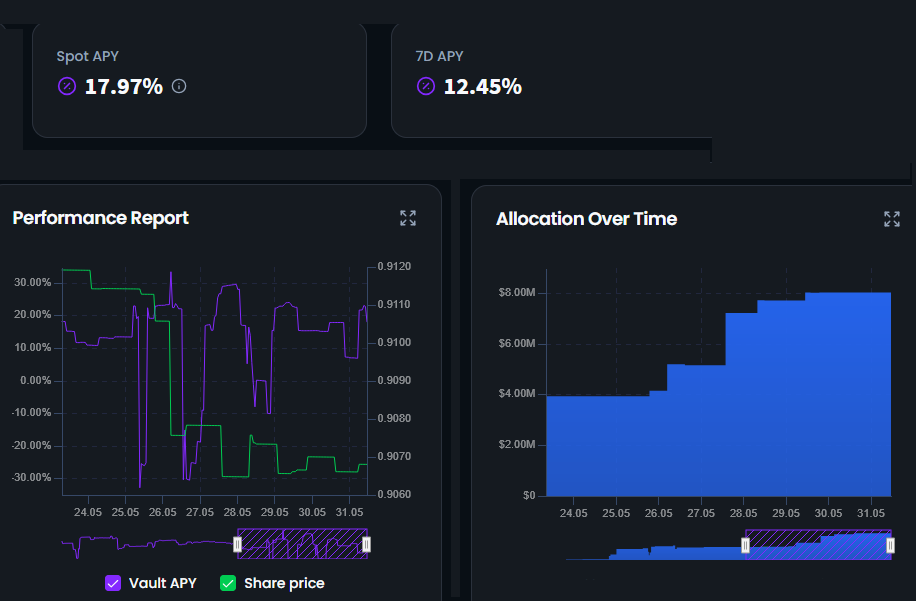
If a new looping vault is set up, which must first grow, each new user deposit causes the leverage to initially decrease and then increase again through further looping, incurring costs that are socialized. This leads to the growth of the share price being lower than it should be based on the profitability of the strategy. In extreme cases, it can even lead to share prices falling even though the strategy is profitable:
*Example: falling share price despite positive 7d APY*
This result can be frustrating for existing users, as they pay for new users to join the vault. A vault with a declining share price can also discourage new users.
On- and offboarding contributions in such vaults would be a way to create more fairness between individual users, as they lead to an increase in the share price. The amount of the contribution should roughly correspond to the costs that experience shows when opening a new leveraged position.
However, charging contributions also has disadvantages, as they could be perceived as a hindrance by users themselves or could impair the composability of the vault.
Ultimately, each Atomist must assess the vault's goals and target audience and, based on this analysis, decide whether or not to charge a contribution. If fairness and a rising share price are particularly important, the Atomist could even choose to slightly overcharge, so that the share price still does not decrease even with unfavorable swap conditions. If integrability is particularly important, the Atomist could also charge a low contribution or even waive a contribution altogether.
### Preventing Arbitrage through Predictable Rebasing
Vaults that utilize rebasing assets, such as `stETH` in a leveraged looping strategy, often exhibit predictable share price movements. Because the underlying protocol distributes yield through a daily rebase at a fixed time, the share price effectively follows a "stair-step" pattern, as illustrated in the chart below.
Without onboarding contributions, opportunistic users can time their deposits to occur just minutes before a scheduled rebase, capturing immediate appreciation without having their capital at risk for a meaningful duration. This behavior socializes the accrued yield across a larger number of shares than contributed to the actual yield generation, directly diluting the returns of long-term participants. By implementing a small onboarding contribution, Atomists can ensure that the cost of entry offsets the immediate arbitrage gain from the rebase event. This protective measure aligns the incentives of all vault participants and preserves the integrity of the share price for those providing continuous liquidity.