> For the complete documentation index, see [llms.txt](https://docs.ipor.io/llms.txt). Markdown versions of documentation pages are available by appending `.md` to page URLs; this page is available as [Markdown](https://docs.ipor.io/build-on-fusion/atomists/curating-a-fusion-vault/share-price-dynamics.md).
# Share Price Dynamics
A Guide (not only) for Atomists
This document aims to provide Atomists with a comprehensive understanding of fusion vault share price behavior and its influencing factors, thereby equipping them to answer user inquiries more effectively.
## What is the share price?
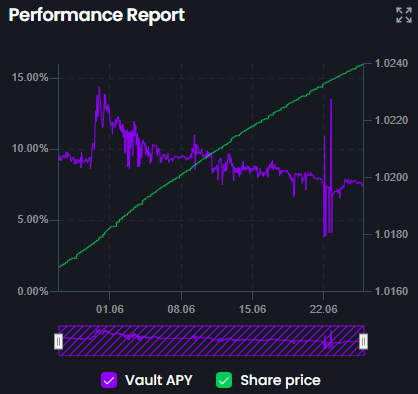
The share price in a DeFi vault represents the vault's Net Asset Value (NAV) per share. It increases as the vault's underlying assets generate yield through automated strategies, allowing users to redeem their shares for a greater value than their initial deposit.
## Influencing factors
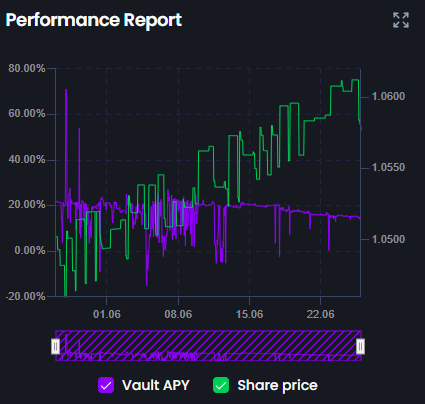
There are numerous events that influence the share price. Some depend on user interactions with the vault, others on the execution of the underlying strategies (Alpha’s actions), and still others on market developments and asset prices. The most important influencing factors will be listed below and illustrated with some examples.
### Yield Generated from Strategies
* Explanation: The primary driver of share price appreciation is the successful execution of the vault's yield-farming strategies. As the vault earns interest, trading fees, or other rewards from its deployed assets, the total value locked (TVL) in the vault increases, directly raising the NAV per share.
* Example: A vault depositing USDC into Aave to earn lending interest will see its share price increase as the accrued interest on the USDC is reinvested.\
\
### Gas Fees
Explanation: Gas fees for Alpha actions do not affect the share price; they are covered by a gas tank funded by either the Atomist or Alpha. Transaction costs are financed through asset management and performance fees.
### Borrow cost
* Explanation: In vaults that employ leveraged strategies, borrow costs (interest paid on borrowed assets) directly impact the share price. These costs are typically accrued continuously (e.g., every block) and reduce the net yield generated by the vault's strategies.
* Example: Consider a vault that borrows ETH to amplify its yield-farming position. If the borrowed ETH incurs an interest rate that is calculated and applied per block, these continuous deductions will eat into the vault's profits. If the underlying asset's price, which contributes to the vault's NAV, is only updated once a day (like wstETH for example), there can be a mismatch. The share price will reflect the continuous reduction from borrow costs in real-time, while the positive impact of the invested asset's daily price appreciation will only be visible after its price update. This can lead to a perceived short-term stagnation or slight decrease in share price, even if the underlying asset is gaining value, until the asset price update factors in (this can be continuous, daily, or less frequently depending on the asset issuer).
### Swap Costs
* Explanation: DEX fees, typically incurred when a strategy necessitates an asset swap, negatively affect the share price. The share price is also impacted by the swap's exchange rate, which is determined by the volume of assets swapped and the liquidity depth of the DEX pool. However, a swap doesn't always result in a lower share price; positive slippage can occur, leading to a higher Net Asset Value (NAV) post-swap.
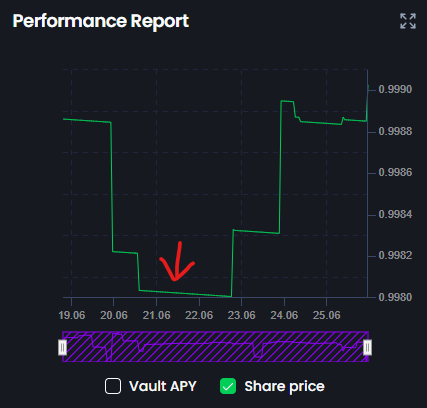
* Example: In a leveraged looping vault (wstETH/ETH), the share price is reduced by transaction costs incurred when ETH is borrowed and swapped for wstETH. The impact of these swap-related costs on the share price increases with the leverage of the strategy. Deposit and withdrawal operations typically involve leverage and de-leverage actions. To protect existing users from these costs, they can be counterbalanced by imposing on- and offboarding contributions.\
*A user deposit made without a onboarding contribution led to a leverage action, which subsequently caused a drop in share price.*
### On- and Offboarding contributions
* Explanation: Fusion Vaults have optional implement on- and offboarding contributions by adjusting the number of vault shares. These are selected by the Atomist to give the best user experience depending on the vault strategy. During deposits, fewer shares are minted, and during withdrawals, shares are burned. Both actions reduce the total number of shares relative to the Net Asset Value (NAV), consequently increasing the share price.
### Other Strategy Costs
Explanation: Expenses deemed strategic, including those associated with token minting or burning, or the deposit/withdrawal of funds from external vaults, may arise from transactions initiated by the Alpha. Such expenditures directly diminish the share price.
### Claiming and Compounding Token Rewards
Explanation: In strategies that generate yield via token rewards from external protocols, Alphas may regularly or irregularly claim these rewards. This action increases the vault's NAV, consequently increasing the share price. When these tokens are then swapped for the underlying asset (compounding), the resulting swap fees can cause a slight share price change (see “Swap Costs”).
### Asset price movements
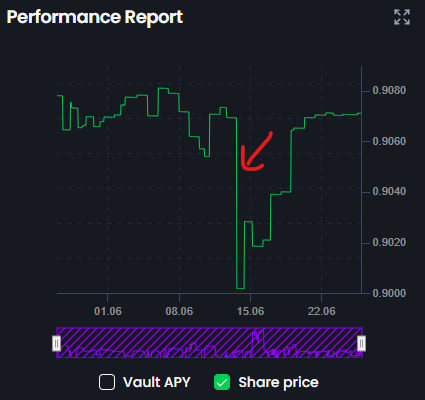
* Explanation: The share price of vaults whose strategy consists entirely or partially of investing in assets other than the vault's base (accounting) asset fluctuates depending on the price fluctuations of the respective assets. Even minimal price fluctuations in otherwise highly correlated assets such as stablecoins can cause significant short-term share price fluctuations, especially in a highly leveraged vault.
* Example: If the vault is denominated in USDC and the strategy is to swap USDC for scrvUSD and loop 20x, even a price fluctuation of 0.0001 USDC/crvUSD can cause a share price change of 0.2%.\
\
* The type of oracle employed by a vault is critical. While market price oracles can lead to share price volatility, hard-coded share price oracles (particularly for pegged assets) mitigate or eliminate such fluctuations. However, this stability comes with the risk that a genuine depreciation might not be reflected in the vault's pricing, potentially triggering a vault run.
### Impermanent Loss (for liquidity provision strategies)
* Explanation: If a vault's strategy involves providing liquidity to an Automated Market Maker (AMM) pool with volatile assets, impermanent loss can occur. This happens when the price ratio of the deposited assets diverges significantly from the initial deposit, leading to a temporary (or permanent if withdrawn) loss in dollar value compared to simply holding the assets.
* Example: A vault providing liquidity to an ETH/USDC pool on Uniswap will experience impermanent loss if the price of ETH rises sharply against USDC. The vault would end up with a higher proportion of USDC and a lower proportion of ETH than if it had just held both assets separately, potentially lowering the vault's overall NAV and thus its share price.
### Smart Contract Risk and Exploits
* Explanation: Although not a direct influencing factor on development of share price, smart contract vulnerabilities or exploits can lead to a sudden and drastic decline in share price due to loss of funds within the vault. This risk is inherent in DeFi.
* Example: If a vault holding large amounts of USDT in a particular lending protocol's smart contract is exploited, and funds are drained, the vault's TVL would plummet, causing its share price also to drop.
### Vault Fees
Explanation: Fusion vaults charge small performance and management fees by minting shares for recipients like Atomists and the IPOR DAO. This process effectively lowers the share price.
see also: [General share price calculation rules](/build-on-fusion/developer-guide/general-share-price-calculation-rules.md)